
What types of AI mobile apps benefit Texas businesses most in 2026?Texas businesses see the highest ROI from AI mobile apps in four areas: field service management (tracking crews, routing, and real-time reporting), customer engagement and loyalty apps with predictive personalization, supply chain visibility tools for logistics-heavy sectors like oil and gas, and AI-powered sales enablement apps for B2B teams. The state’s dominant industries in energy, construction, logistics, and healthcare each have specific AI app use cases that deliver measurable efficiency gains. |
Table of Contents
- Texas as a Technology Market in 2026
- The Four AI App Categories That Work Best for Texas Industries
- Industry Spotlight: Energy, Construction, and Logistics
- What to Build First: Prioritizing Your AI App Investment
- Choosing the Right Development Partner for a Texas Business
- Frequently Asked Questions
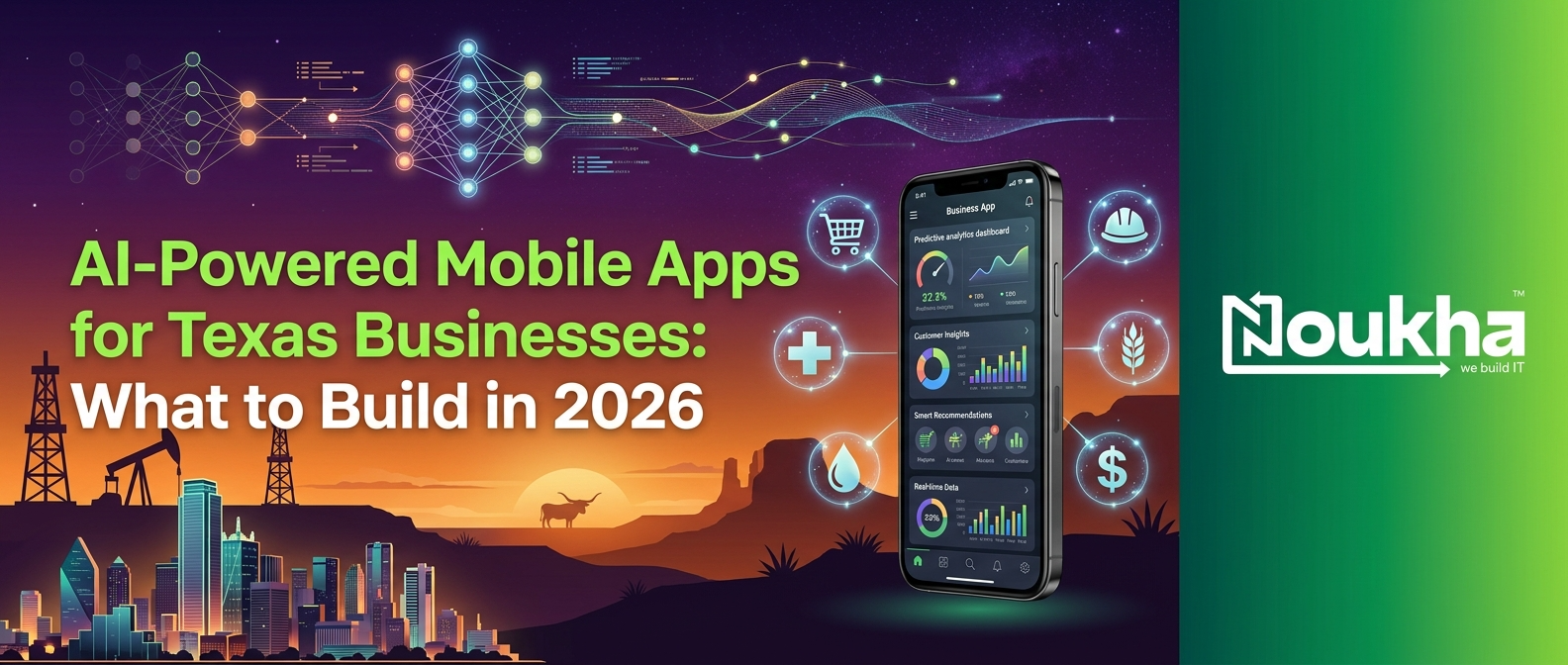
AI-Powered Mobile Apps for Texas Businesses: What to Build and How
Introduction
Texas is not a single business market. It is a cluster of distinct economic ecosystems: the energy sector anchored in Houston, the tech corridor stretching from Austin to Dallas, the logistics and manufacturing concentration around San Antonio, and the booming healthcare market that spans the entire state. Each of these sectors has distinct operational challenges, and in 2026, AI-powered mobile apps are emerging as the most practical tool for addressing them.
The conversation has shifted from whether Texas businesses should invest in AI apps to which ones to build first. This guide cuts through the noise and maps the most valuable AI mobile app categories to the industries where they deliver the clearest return.
1. Texas as a Technology Market in 2026
Texas has become one of the most active technology investment markets in the United States. The migration of major corporations to the state over the past five years has created a concentration of enterprise demand for software solutions that was not present a decade ago.
At the same time, the state’s large SMB base, particularly in construction, oilfield services, agriculture, and retail, is undergoing a digital transformation that is catching up with coastal markets quickly. Mobile-first solutions are disproportionately valuable here because Texas’s geographic spread means workforces are frequently distributed across large distances.
The result is a tech market that rewards practical, outcome-oriented AI applications over speculative technology. Texas businesses buy tools that make their crews more efficient, their customers more loyal, and their operations more visible. These are exactly the conditions AI-powered mobile apps are built for.
2. The Four AI App Categories That Work Best for Texas Industries
Field Service Management Apps
Texas has one of the largest field service workforces in the country, covering everything from HVAC and electrical to oil and gas maintenance. AI-powered field service apps with real-time job routing, predictive maintenance alerts, and mobile inspection reporting reduce drive time, eliminate paper-based workflows, and give operations managers live visibility into crew activity.
Customer Loyalty and Personalization Apps
Texas retail, hospitality, and food service businesses are investing in AI-driven loyalty apps that move beyond point accumulation. These platforms analyze purchase history, predict churn, and deliver personalized offers at the right moment.
Supply Chain Visibility Tools
For energy, logistics, and manufacturing companies, knowing where inventory, equipment, and shipments are in real time is operationally critical. AI-powered supply chain apps ingest data from IoT sensors, carrier systems, and internal platforms to give decision-makers a single mobile interface for tracking and intervention.
B2B Sales Enablement Apps
Texas has a dense B2B economy across sectors like industrial equipment, oilfield supply, and commercial real estate. AI sales apps that surface deal intelligence, automate follow-up, and prioritize leads based on behavioral signals have shown strong adoption among outside sales teams who spend most of their time away from a desk.
3. Industry Spotlight: Energy, Construction, and Logistics
Energy Sector
Oil and gas companies in Texas face ongoing pressure to do more with fewer field personnel. AI apps in this space focus on predictive equipment monitoring, safety compliance checklists, and real-time reporting from remote well sites. The ability to collect and analyze data from locations with limited connectivity requires on-device AI capabilities, an area where mobile app development has advanced considerably.
Construction
Texas construction is booming, particularly in the major metros. Project managers are using AI mobile apps for progress tracking, subcontractor coordination, and materials procurement. Computer vision features that let site supervisors photograph progress and auto-generate status updates are gaining rapid adoption among general contractors.
Logistics and Transportation
With major distribution hubs in Dallas and Houston, Texas logistics companies handle enormous freight volumes. Route optimization apps with real-time traffic and weather integration, driver performance monitoring, and automated customer notification systems have cut operational costs and improved delivery SLA performance for carriers of all sizes.
4. What to Build First: Prioritizing Your AI App Investment
Texas business owners often ask the same question: we know we need an AI app, but where do we start? The prioritization framework that works best in practice has three filters:
- Volume: which workflow touches the most employees or customers every day? High volume means faster ROI measurement.
- Pain: where is the current process most visibly broken, expensive, or error-prone? Solve a real pain point rather than adding a nice-to-have.
- Data availability: AI apps improve with data. Start with a workflow where you already have usable historical data.
Texas companies often benefit from working with a team experienced in mobile app development in Texas who understand the state’s specific industry verticals. For businesses that want AI-native capabilities built into the core architecture from day one, a dedicated AI app development company in the USA ensures the foundation is built for scale rather than bolted on later.
5. Choosing the Right Development Partner for a Texas Business
The Texas market has specific expectations that not all development partners meet. Local business culture values directness, practical outcomes, and accountability. An ideal development partner for a Texas-based company should demonstrate:
- Familiarity with Texas’s dominant industries and the regulatory environments they operate in, particularly energy and construction
- Experience building apps that work reliably with limited or intermittent connectivity, given the state’s rural and remote operational sites
- A clear project management approach with defined milestones, not open-ended time-and-materials billing
- References from clients in similar industries with measurable business outcomes
- Capacity to support and iterate on the app post-launch, not just deliver a finished product and disengage
Frequently Asked Questions
Q1. How long does it take to build an AI mobile app for a Texas business?
A focused, single-workflow AI mobile app with a clear scope typically takes 12 to 20 weeks from kickoff to production launch. More complex applications with multiple integrations and custom AI models take 6 to 9 months.
Q2. Do I need to replace my existing software to add an AI mobile app?
In most cases, no. Well-designed AI apps integrate with existing ERP, CRM, and operations software via APIs. The goal is to extend and enhance what you have, not replace it entirely.
Q3. What is a realistic budget for a mid-market Texas business building an AI app?
For a focused single-platform AI mobile app, budgets typically range from $80,000 to $250,000 depending on complexity, integrations, and AI feature depth.
Q4. Can small Texas businesses afford AI mobile apps?
Yes, particularly with offshore development partners who offer the same quality at lower price points. A small Texas construction firm might commission a field inspection app with AI-powered report generation for $40,000 to $70,000, a cost that pays back within one operating season through time savings.
Q5. Is my industry data safe when building an AI app with an outside developer?
Reputable development partners use enterprise-grade security practices including encrypted data transfer, NDA agreements covering all data shared during development, and code ownership structures that ensure you control your data architecture from day one.
Conclusion
Texas businesses that are investing in AI mobile apps in 2026 are not doing it to be early adopters. They are doing it because the operational advantages are concrete and measurable: field teams that cover more ground, customers who come back more often, supply chains that surface problems before they become crises.
The starting point matters more than the ambition. A focused, well-executed first AI app creates the data foundation and internal confidence to build the second one faster and better. Start with the workflow that costs you the most today, and build from there.
About the Author
| Ramanathan Alagappan
Founder and CEO, Noukha Technologies Ramanathan Alagappan is the Founder and CEO of Noukha Technologies, with over 13 years of hands-on experience in product engineering, platform architecture, and technology leadership. He has previously served in CTO and senior engineering roles, where he was responsible for taking products from concept to scale in SaaS and platform-driven businesses. At Noukha, his work centers on building AI-powered mobile and web systems that solve real operational challenges for businesses across industries. |
About The Author